Rural education essential for sustainable community growth, helping readers understand its social, economic, and human development impact with clarity and care.
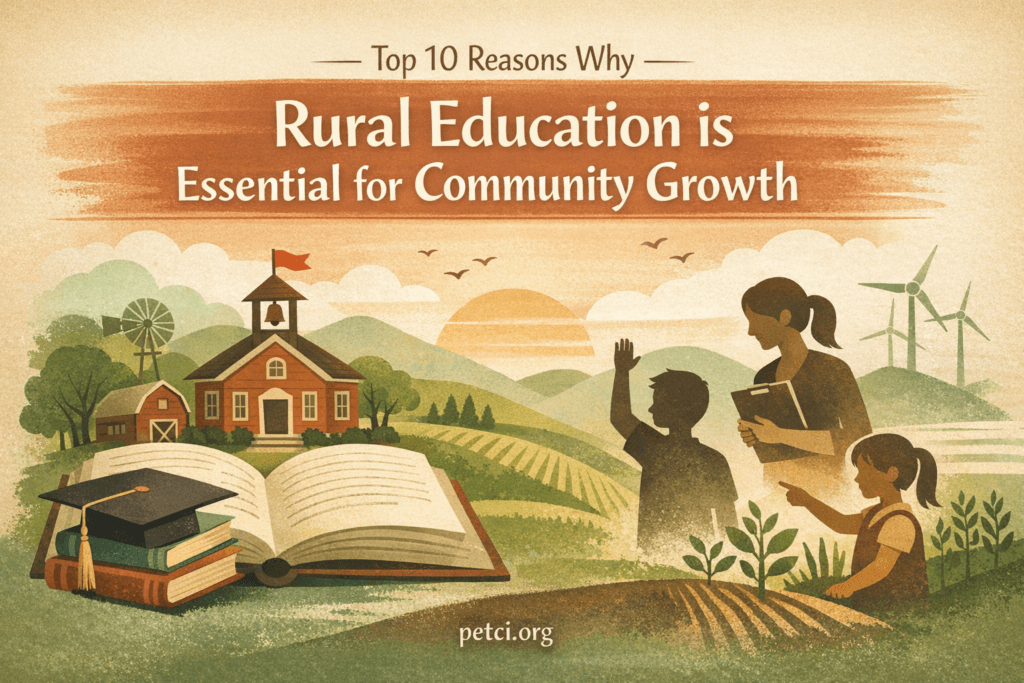
Table of Contents
🌱 Rural Education Essential: 10 Transformative Reasons for Growth
Introduction: When a Village Learns, the Future Awakens
In the quiet rhythm of rural life—where fields replace skylines and communities are bound by generations rather than infrastructure—education becomes more than schooling. It becomes survival, continuity, dignity, and hope.
Yet across the world, rural education remains one of the most underserved pillars of development. While cities surge ahead with digital classrooms, specialized institutions, and global exposure, rural communities often struggle with teacher shortages, limited facilities, long travel distances, and outdated resources.
And still, when education reaches a village authentically, something remarkable happens.
Children do not just learn to read.
Farmers learn to adapt.
Families learn to thrive.
Communities learn to shape their own futures.
This is why rural education is essential—not as charity, but as the most powerful engine of community growth.
This article explores the top 10 reasons why rural education is essential for community growth, drawing from social science, development studies, real-world community models, and deeply human realities.
Understanding Rural Education in a Broader Sense
Rural education is often misunderstood as merely “schooling in villages.” In reality, it includes:
- Foundational literacy and numeracy
- Agricultural and environmental education
- Health and hygiene awareness
- Women’s and adult education
- Skill-based and vocational training
- Digital and financial literacy
- Civic and leadership development
It is education aligned with life, not separated from it.
When rural education systems are designed around community needs, culture, ecology, and local economy, they become transformative rather than instructional.
🌍 Top 10 Reasons Why Rural Education Is Essential for Community Growth
1. Rural Education Strengthens Local Economies from the Roots
Community growth begins with economic dignity.
Rural education equips people with the ability to:
- Improve agricultural productivity
- Diversify income sources
- Manage finances responsibly
- Develop local enterprises
- Adapt to changing markets and climates
Case Insight
A farming community that understands soil science, water management, crop rotation, and basic agribusiness transforms from subsistence survival to sustainable livelihood.
Instead of migrating out of necessity, educated rural youth can:
- Build food processing units
- Launch cooperatives
- Introduce eco-tourism
- Develop renewable energy solutions
- Modernize traditional trades
Education keeps wealth circulating locally, creating employment ecosystems rather than dependency pipelines.
2. Rural Education Reduces Generational Poverty Cycles
Poverty persists where choice is absent.
Rural education introduces:
- Awareness of rights and opportunities
- Skill-based independence
- Health and nutrition literacy
- Financial decision-making capacity
Deep Insight
When one child becomes educated in a rural household, the ripple effect reaches:
- Younger siblings
- Parental decision-making
- Community health practices
- Women’s autonomy
- Long-term family planning
Education interrupts inherited vulnerability and replaces it with intergenerational resilience.
It does not erase struggle.
It makes struggle meaningful, navigable, and constructive.
3. Rural Education Improves Community Health and Longevity
Healthcare access is limited in many rural areas. Education often becomes the first and most reliable line of prevention.
Educated rural communities show:
- Lower maternal and infant mortality
- Better sanitation and hygiene practices
- Improved nutrition choices
- Early disease recognition
- Reduced addiction patterns
Example
A literate mother is statistically far more likely to:
- Vaccinate her children
- Maintain hygiene practices
- Seek timely medical care
- Educate others informally
Rural education does not replace hospitals.
It reduces the burden on them by building biological intelligence at the grassroots.
4. Rural Education Empowers Women and Reshapes Social Balance
One of the most profound impacts of rural education is its effect on women’s agency.
Educated rural women are more likely to:
- Participate in economic activity
- Delay early marriage
- Ensure children’s schooling
- Access healthcare
- Engage in community leadership
Community Transformation Insight
When women are educated:
- Child nutrition improves
- Domestic violence decreases
- Family incomes stabilize
- Girls remain in school
- Community decisions humanize
Rural education becomes not just academic—it becomes civilizational.
5. Rural Education Preserves Culture While Preparing for the Future
Contrary to fear, rural education does not destroy tradition. When designed ethically, it protects it.
It helps communities:
- Document indigenous knowledge
- Sustain ecological practices
- Preserve language and crafts
- Integrate tradition with innovation
Example
A rural school teaching:
- Local farming wisdom
- Herbal knowledge
- Folk arts
- Environmental ethics
alongside science and technology builds a rooted modernity rather than cultural erosion.
Rural education ensures that development does not become displacement.
6. Rural Education Builds Leadership from Within
Communities grow sustainably only when leadership emerges from inside, not imposed from outside.
Rural education nurtures:
- Critical thinking
- Ethical reasoning
- Civic understanding
- Conflict resolution
- Organizational capacity
Result
Villages begin producing:
- Teachers
- Health workers
- Social entrepreneurs
- Environmental stewards
- Local administrators
Instead of waiting for solutions, communities begin designing them.
7. Rural Education Promotes Environmental Responsibility
Rural communities live closest to land, water, and biodiversity. Education transforms this proximity into ecological guardianship.
Educated rural populations are more capable of:
- Sustainable farming
- Soil and water conservation
- Climate adaptation
- Waste management
- Biodiversity protection
Insight
Rural education aligns survival with sustainability.
When children understand how ecosystems work, they no longer inherit land—they protect living systems.
This directly impacts food security, climate resilience, and disaster preparedness.
8. Rural Education Reduces Migration Pressure and Urban Overload
One of the silent costs of weak rural education is forced migration.
People leave not for opportunity—but for dignity.
Strong rural education systems create:
- Local employment possibilities
- Entrepreneurial confidence
- Skill-based rural industries
- Technological inclusion
This allows communities to:
- Retain youth
- Maintain family structures
- Strengthen regional economies
- Reduce slum expansion
- Ease urban resource strain
Community growth is not urbanization.
It is a regional balance.
9. Rural Education Enhances Social Harmony and Civic Participation
Education expands not just intelligence, but social consciousness.
Rural education promotes:
- Legal awareness
- Conflict resolution
- Community dialogue
- Cooperative development
- Democratic participation
Educated communities are more likely to:
- Protect vulnerable groups
- Resist exploitation
- Participate in governance
- Demand accountability
- Build collective initiatives
Growth becomes not just economic—it becomes ethical.
10. Rural Education Secures the Future Through Children
Children educated in rural contexts develop a unique synthesis:
- Practical intelligence
- Ecological sensitivity
- Community responsibility
- Cultural continuity
- Adaptive resilience
They become bridges between:
Tradition and innovation
Nature and technology
Community and globalization
When rural children are educated holistically, community growth becomes inevitable, not accidental.
📊 A Snapshot of Rural Education’s Community Impact
| Domain | Community Change Enabled |
|---|---|
| Economy | Local enterprise, agricultural innovation, employment |
| Health | Prevention awareness, nutrition, hygiene, maternal care |
| Society | Gender equity, reduced violence, stronger families |
| Environment | Sustainable practices, conservation, climate resilience |
| Governance | Leadership, civic engagement, legal awareness |
| Culture | Preservation of indigenous knowledge and identity |
| Youth | Reduced migration, entrepreneurial confidence |
🌿 The Deeper Truth About Rural Education
Rural education is not infrastructure.
It is identity engineering.
It shapes how communities:
- Understand themselves
- Relate to nature
- Solve problems
- Raise children
- Define success
When rural education is ignored, development becomes extractive.
When rural education is nurtured, development becomes regenerative.
🌱 Conclusion: Community Growth Begins Where Education Takes Root
True community growth is not measured by buildings.
It is measured by capacity.
Not by roads.
But by reasoning.
Not by population.
But by participation.
Rural education is essential because it turns communities from beneficiaries into builders.
And when villages learn to build their own future, the world becomes stronger from its foundations.
✅ FAQ SECTION
1. Why is rural education essential for sustainable development?
Because it builds local skills, ecological responsibility, economic resilience, and leadership from within the community, ensuring long-term, self-directed growth.
2. How does rural education differ from urban education needs?
Rural education integrates livelihood skills, environmental awareness, community health, and indigenous knowledge alongside academics.
3. Can rural education really reduce poverty?
Yes. Education improves employability, entrepreneurship, health practices, and financial literacy—key drivers in breaking generational poverty.
4. What role does rural education play in women’s empowerment?
It increases autonomy, economic participation, health awareness, and leadership opportunities, reshaping family and social structures.
5. How does rural education support environmental protection?
By teaching sustainable agriculture, conservation science, climate adaptation, and ecological ethics rooted in local realities.
6. Is rural education only about children?
No. Adult education, women’s education, farmer training, and community learning programs are equally essential.
✅ PROFESSIONAL DISCLAIMER
Disclaimer:
This article is intended for educational and social awareness purposes only. While it reflects research-backed perspectives on rural education and community development, it does not substitute for governmental, institutional, or professional policy planning. Community development strategies should always be designed with local consultation, ethical frameworks, and context-specific research.
This article is composed by Dr. G. K. Gyan, with the help of AI tools.