Forest management carbon cycle insights to build a clear, compassionate understanding of how forests influence carbon balance, resilience, and climate responsibility.
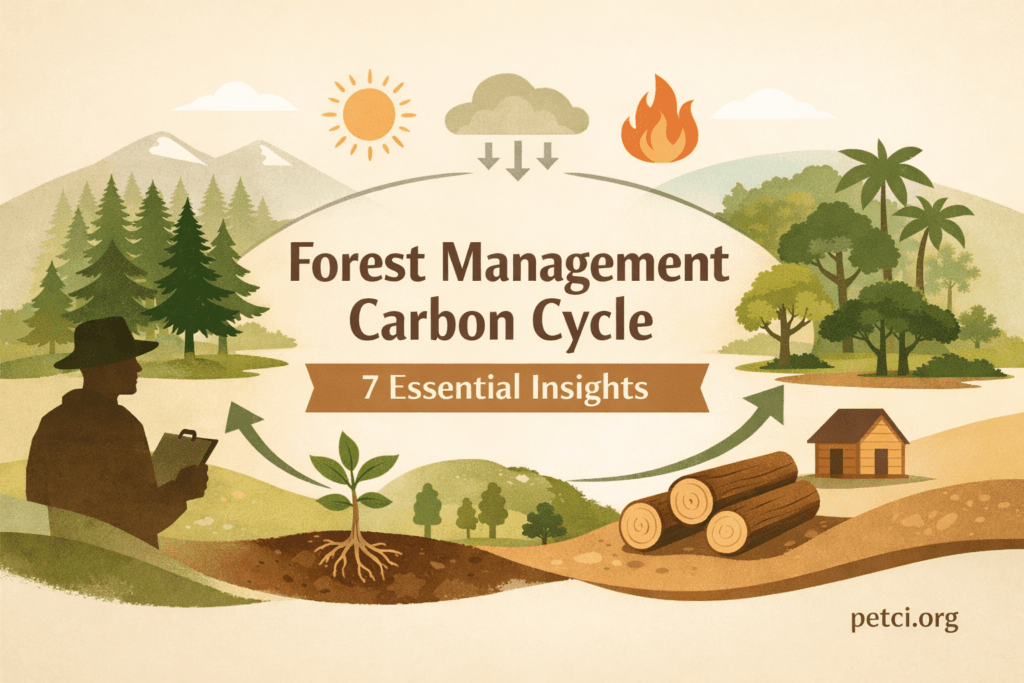
Table of Contents
Forest Management Carbon Cycle: Understanding a Living Climate System
How human stewardship of forests quietly shapes the planet’s breath, balance, and biological memory
Introduction: The silent architecture of climate balance
Forests are often described as the “lungs of the Earth.” The phrase is poetic, but it is also scientifically incomplete. Forests do far more than exchange oxygen and carbon dioxide. They act as long-term carbon vaults, dynamic climate regulators, biodiversity sanctuaries, hydrological engineers, and living archives of planetary history.
At the center of these roles lies the forest management carbon cycle—a complex, sensitive system through which carbon is absorbed, stored, transformed, and released. Every thinning operation, conservation policy, fire regime, restoration effort, or plantation decision subtly reshapes this cycle. Some choices strengthen Earth’s natural cooling mechanisms. Others, even when well-intended, can weaken them.
Forest management does not influence a single “carbon number.” It reshapes:
- how quickly carbon is absorbed from the atmosphere,
- where it is stored (leaves, trunks, roots, soils, wood products),
- how long it remains locked away,
- and how vulnerable it is to disturbance, decay, or combustion.
Understanding this living system is no longer optional. In a climate-stressed world of rising temperatures, megafires, biodiversity collapse, and land-use pressure, how we manage forests may determine whether they remain climate allies—or quietly become carbon liabilities.
This article explores the forest management carbon cycle not as a slogan, but as a deeply interconnected biological reality—grounded in research, ecological principles, and human responsibility.
1. The forest management carbon cycle: a living exchange, not a static stock
At its foundation, the forest carbon cycle is governed by a continuous balance between inputs and outputs.
Carbon enters forests primarily through:
- Photosynthesis (CO₂ → plant biomass)
- Litter deposition (leaves, wood fragments, roots)
- Root exudates feeding soil carbon pools
Carbon leaves forests through:
- Plant respiration
- Microbial decomposition
- Wildfire and pest-driven mortality
- Harvesting and land conversion
Forest management intervenes in this balance. It alters the speed, location, and stability of carbon flows.
Rather than asking, “Does this forest store carbon?” a more meaningful question is:
Where is the carbon held, for how long, and how safely?
Because carbon in fast-growing leaves behaves very differently from carbon bound into deep, mineral-associated soil pools or long-lived timber products.
Forest management decisions, therefore, are not merely ecological. They are temporal decisions—choices about whether carbon will remain locked away for decades, centuries, or only a few seasons.
2. Forest type matters: boreal, temperate, and tropical systems respond differently
The forest management carbon cycle is profoundly shaped by geography and climate.
Boreal forests
- Store most of their carbon belowground (peat, organic soils, permafrost)
- Have slow growth but massive long-term carbon reservoirs
- Are highly sensitive to fire and warming-induced soil carbon loss
Management risks here are less about tree cutting alone and more about disturbing soils, altering albedo, and increasing fire susceptibility.
Temperate forests
- Balance moderate productivity with substantial soil and biomass storage
- Often show strong responses to thinning, mixed-species management, and age-structure diversity
- Offer high potential for sustainable wood products and long-lived carbon pools
These forests are frequently where active management strategies have the most flexibility.
Tropical forests
- Exhibit very high carbon uptake rates
- Store enormous quantities in standing biomass
- Are extremely vulnerable to deforestation, fragmentation, and drought
Here, the dominant climate strategy is often protection first, management second.
Understanding forest management carbon cycle dynamics without forest type differentiation leads to policies that may look efficient on paper but fail ecologically.
3. Structural manipulation: how thinning reshapes carbon destiny
One of the most misunderstood interventions in forest management is thinning.
At first glance, removing trees seems incompatible with carbon conservation. Yet large-scale global analyses have revealed a more complex picture.
What thinning actually changes
- Reduces competition for light, water, and nutrients
- Enhances growth rates of remaining trees
- Shifts microbial communities
- Alters litter composition and soil respiration patterns
In many systems, these changes lead to:
- higher long-term aboveground carbon accumulation,
- increased structural stability,
- and improved drought resilience.
Thinning does not simply remove carbon—it redistributes growth capacity. Fewer trees, growing more efficiently, can over time store more stable carbon than dense, stressed stands prone to mortality.
However, intensity matters
- Moderate thinning can enhance carbon resilience.
- High-intensity intervention can suppress natural accumulation pathways.
- Poorly timed thinning can increase disturbance vulnerability.
This is why forest management carbon cycle outcomes are practice-specific, not universally transferable.
4. Active management versus strict protection: not a binary choice
Much of the public discourse frames forest policy as a conflict between:
- “Leave forests alone”
- “Manage forests for production”
Carbon science suggests a more nuanced reality.
Strict protection: carbon reservoirs
Unmanaged forests—particularly mature and old-growth systems—act as:
- Massive carbon banks
- Slow but persistent carbon sinks
- Biodiversity and microclimate stabilizers
Research consistently shows that many protected forests continue accumulating carbon for decades after management cessation, particularly in soils and coarse woody debris.
Their value lies not in rapid uptake, but in longevity, complexity, and disturbance buffering.
Active management: carbon pumps
Managed forests can:
- Maintain stands in high-growth phases
- Supply long-lived wood products
- Substitute for carbon-intensive materials
- Regenerate younger cohorts with high sequestration rates
When responsibly practiced, active management can extend the carbon cycle beyond the forest, storing carbon in buildings, furniture, and engineered wood.
The emerging consensus
The forest management carbon cycle operates most effectively at the landscape scale, where:
- protected forests preserve deep carbon stocks,
- managed forests drive renewable sequestration,
- and restoration zones enhance connectivity and resilience.
It is not management versus protection. It is strategic orchestration.
5. Afforestation and reforestation: opportunity with conditions
Planting trees has become a global symbol of climate action. But forests are not simply “carbon sponges.” They are ecosystems.
Afforestation adds new carbon reservoirs
Establishing forests on long-unforested land can:
- draw atmospheric carbon into new biomass pools,
- rebuild soil organic matter,
- moderate regional climates,
- and restore degraded hydrological cycles.
Large national programs demonstrate that afforestation can accumulate billions of tons of carbon over decades.
But effectiveness depends on:
- prior land-use history
- soil characteristics
- species selection
- water availability
- long-term governance
Poorly planned afforestation can:
- deplete water tables,
- reduce albedo in snowy regions,
- threaten grassland biodiversity,
- or store unstable carbon prone to rapid loss.
Forest tending versus forest creation
In many regions, research increasingly shows that managing existing forests—improving structure, resilience, and regeneration—can be more cost-effective and ecologically safer than large-scale new planting.
The forest management carbon cycle therefore extends beyond “how many trees,” toward how forests function.
6. Soil: the unseen heart of the forest carbon cycle
Over half of all forest carbon often lies belowground.
Soil carbon exists in forms ranging from:
- fast-cycling microbial biomass
- to stable mineral-associated organic matter
- to ancient peat and charcoal fractions
Forest management influences these pools profoundly.
Management actions affecting soil carbon
- Thinning alters root turnover and microbial composition
- Species selection changes litter chemistry
- Harvest methods determine soil disturbance levels
- Fire regimes reshape long-term carbon chemistry
Subtle shifts in microbial communities can determine whether soils:
- respire carbon rapidly back to the atmosphere,
- or stabilize it into multi-century pools.
Because soil carbon is slow to build and easy to lose, carbon-smart forest management must treat soil as infrastructure.
7. Beyond carbon: biophysical feedbacks that reshape climate impact
A forest’s climate role is not governed by carbon alone.
Management alters:
- surface reflectivity (albedo)
- evapotranspiration rates
- aerosol and volatile compound emissions
- turbulence and cloud formation
In high-latitude regions, darker coniferous forests can reduce snow reflectivity, potentially warming local climates even as carbon increases.
In tropical zones, forest evapotranspiration can amplify cloud formation, reinforcing regional cooling cycles.
Thus, the forest management carbon cycle must be understood as part of a broader climate physics system, not merely a carbon accounting ledger.
8. Disturbance, resilience, and permanence
Carbon sequestration is only as valuable as it is durable.
Climate change is amplifying:
- drought stress
- insect outbreaks
- megafires
- storm damage
- heat-induced mortality
Recent research demonstrates that forests recovering from one disturbance often become more vulnerable to subsequent ones, weakening long-term carbon retention.
Resilience-oriented management includes:
- structural diversity
- mixed species composition
- landscape connectivity
- fire-adapted planning
- genetic variability
- water-sensitive design
The future of the forest management carbon cycle may depend less on how much carbon we store, and more on how safely we store it.
9. Carbon pathways: where forest carbon actually goes
Forest management does not simply “store carbon in trees.” It channels carbon into multiple pathways.
| Carbon Pool | Role in Climate Regulation | Stability |
|---|---|---|
| Live biomass | Rapid uptake, visible storage | Moderate |
| Deadwood | Long-term structural carbon | Moderate–high |
| Soil organic matter | Largest long-term reservoir | High |
| Harvested wood products | Extended off-site storage | Variable |
| Bioenergy substitution | Fossil fuel displacement | Indirect |
| Charcoal/biochar | Millennial-scale carbon | Very high |
Management choices determine whether carbon flows primarily into ephemeral foliage or into deep-time reservoirs.
10. Ethical forest management in a carbon-constrained world
Forests are not carbon machines. They are living communities.
The forest management carbon cycle intersects with:
- Indigenous stewardship
- rural livelihoods
- water security
- food systems
- spiritual and cultural landscapes
- intergenerational justice
Carbon-centered policies that ignore these dimensions risk creating ecological simplifications that ultimately destabilize the very systems they aim to protect.
True climate-aligned forest management therefore requires:
- humility before complexity
- respect for ecological limits
- long-term monitoring
- adaptive governance
- and ethical restraint.
Conclusion: from carbon accounting to ecological wisdom
Forest management is neither a guaranteed solution nor an inherent threat. It is a powerful instrument whose climate effects are shaped by intention, scale, and understanding.
The forest management carbon cycle teaches us that:
- carbon is not stored, it is entrusted,
- forests are not tools, they are relationships,
- and management is not control, but participation in living systems.
When guided by ecological literacy, forest management can strengthen Earth’s capacity to regulate its climate while supporting biodiversity, livelihoods, and resilience.
When driven by short-term metrics alone, it risks dissolving ancient carbon vaults into momentary gains.
The climate conversation, therefore, must mature—from counting trees to cultivating forests.
Because in the end, the carbon cycle is not only a chemical process.
It is a biological memory of how humanity chooses to belong to the Earth.
4. FAQ
1. What does the forest management carbon cycle mean?
It refers to how forest management influences carbon absorption, storage, transformation, and release across trees, soils, deadwood, and harvested products.
2. Is forest management always good for climate mitigation?
No. Outcomes depend on forest type, intervention intensity, soil protection, disturbance risk, and long-term resilience planning.
3. Are unmanaged forests better carbon sinks than managed forests?
They are often better long-term reservoirs, while managed forests may offer faster sequestration and off-site storage through wood products.
4. Why is soil carbon so important?
Because it represents the largest and most stable carbon pool, often exceeding all aboveground biomass combined.
5. Does planting more trees always increase climate benefits?
Not necessarily. Poorly planned afforestation can harm water cycles, biodiversity, and even net climate balance.
6. How does thinning sometimes increase carbon storage?
By reducing competition, it can accelerate growth of remaining trees and enhance long-term biomass accumulation.
7. What is the greatest threat to forest carbon today?
Rising climate-driven disturbances that destabilize stored carbon and reduce long-term forest resilience.
5. Professional Disclaimer
This article is intended for educational and awareness purposes only. It does not substitute for site-specific ecological assessments, professional forestry guidance, or climate policy planning. Forest management decisions should always involve qualified environmental professionals, local ecological knowledge, and long-term monitoring frameworks.
This article is composed by Dr. G. K. Gyan, with the help of AI tools.