Vocational training offers practical career clarity, confidence, and employable skills. This guide explains how vocational training supports students and parents in informed decisions.
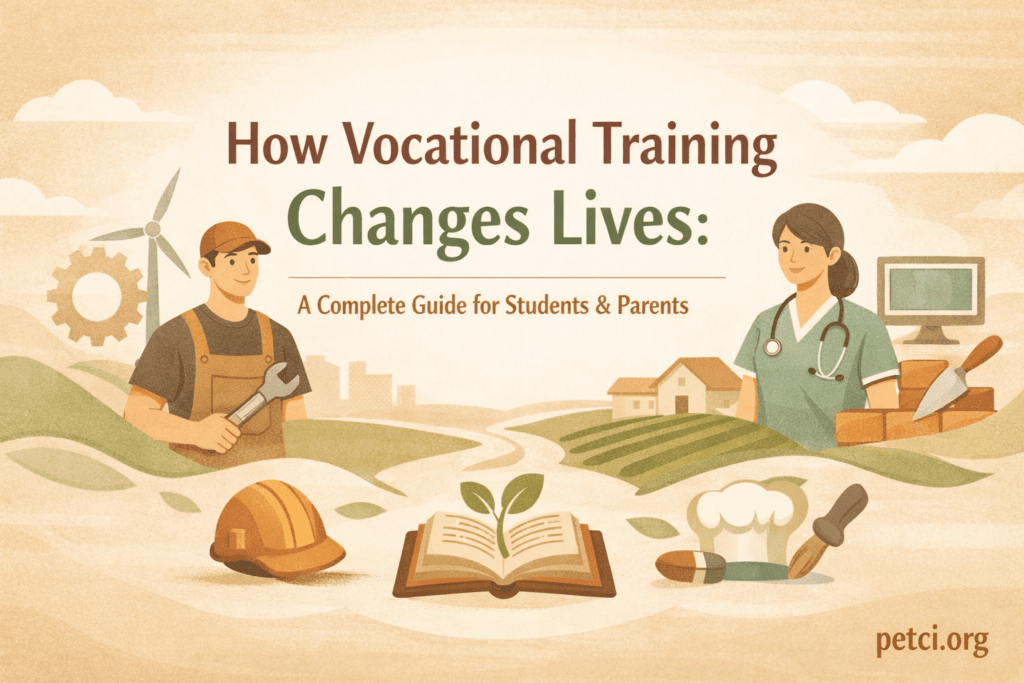
Table of Contents
How Vocational Training Changes Lives: A Complete Guide for Students & Parents
Introduction: When Education Begins to Heal, Not Just Instruct
For generations, education has been measured by degrees, marks, and prestige. Yet quietly, across towns, villages, and cities alike, another form of learning has been reshaping destinies—often without applause, but with profound impact.
Vocational training does not merely prepare students for jobs. It restores dignity to work, clarity to confused futures, and confidence to young minds who may not fit into rigid academic systems. It speaks a language of hands, hearts, and real-world relevance.
For many families, especially those standing at crossroads of uncertainty, vocational education becomes not a compromise—but a turning point.
This guide is written for students seeking direction and parents seeking security. It explores how vocational training changes lives, not in slogans, but in substance.
Understanding Vocational Training in Its True Sense
What Is Vocational Training?
Vocational training is a structured form of education focused on developing practical, job-ready skills aligned with specific occupations or industries. It emphasizes doing as much as knowing.
Unlike conventional academic pathways that prioritize theory, vocational education centers on:
- Skill mastery
- Real-world problem-solving
- Industry-relevant tools
- Work-based learning
- Career readiness
It prepares learners not just to pass exams—but to participate meaningfully in society’s working systems.
Vocational Education vs Conventional Academics
| Aspect | Conventional Education | Vocational Training |
|---|---|---|
| Focus | Theory & credentials | Practical skills & employability |
| Learning style | Classroom-centered | Hands-on & applied |
| Outcome | Degree-oriented | Career-oriented |
| Assessment | Exams | Demonstration of competence |
| Entry into workforce | Delayed | Early and supported |
| Student fit | Narrow | Broad & inclusive |
Neither path is superior. But vocational training serves those whom traditional systems often overlook—creative minds, tactile learners, problem-solvers, builders, fixers, healers.
Why Vocational Training Matters More Than Ever
The modern world is changing faster than degrees can keep pace.
Automation, climate transitions, healthcare expansion, digital infrastructure, renewable energy, and skilled trades are reshaping employment landscapes. Industries increasingly seek competence over certificates.
Vocational education responds directly to this reality.
It creates:
- Workforce resilience
- Youth employability
- Local economic stability
- Self-reliant communities
- Ethical entrepreneurship
More importantly, it restores human relevance in a world of mechanization.
How Vocational Training Changes Lives
1. It Restores Purpose to Education
Many students disengage not because they lack intelligence—but because they lack relevance.
Vocational courses reconnect learning with life. When a student sees that what they learn today repairs a machine tomorrow, heals a patient next year, or feeds a community soon after—education becomes meaningful again.
Purpose reduces dropout rates.
Purpose strengthens discipline.
Purpose nurtures mental wellbeing.
2. It Builds Confidence Through Capability
Self-esteem grows not from praise, but from proven ability.
Vocational training allows learners to:
- Build tangible outcomes
- Solve real problems
- Earn early respect
- Contribute economically
- Support their families
A young person who can wire a home, assist in healthcare, design digital systems, or cultivate sustainable farms develops a quiet, grounded confidence.
They stop asking, “Am I good enough?”
They start saying, “I can.”
3. It Creates Early and Ethical Livelihood Pathways
While many academic graduates struggle for years to find alignment, vocational learners often enter income-generating roles earlier, with clearer expectations and fewer illusions.
Vocational education supports:
- Apprenticeships
- Micro-enterprises
- Service-based livelihoods
- Skilled employment
- Cooperative work models
This is not about chasing money. It is about earning stability without surrendering self-worth.
4. It Supports Diverse Intelligences
Not all minds flourish in lecture halls.
Some think through hands.
Some understand through construction.
Some learn through service.
Some express through repair, cultivation, design, or care.
Vocational training respects multiple intelligences—technical, spatial, interpersonal, mechanical, environmental, artistic.
It tells students:
You are not weak. You are wired differently.
5. It Strengthens Communities, Not Just Careers
Every trained electrician lights more than homes.
Every healthcare aide supports entire families.
Every agricultural technician nourishes ecosystems.
Vocational training multiplies social good.
Communities with strong vocational institutions experience:
- Reduced unemployment
- Improved local services
- Youth retention
- Safer infrastructures
- Sustainable development
The impact travels outward—from individual to household, from household to society.
Key Vocational Training Sectors Transforming Futures
Vocational education is not limited to trades alone. It spans nearly every dimension of human service and innovation.
Health & Care Services
- Community health workers
- Medical technicians
- Elder care assistants
- Rehabilitation aides
Impact: Compassionate employment, public health resilience, service dignity.
Technology & Digital Skills
- IT support
- Web development
- Digital design
- Cyber maintenance
Impact: Modern workforce readiness, global connectivity, innovation pathways.
Skilled Trades & Infrastructure
- Electrical systems
- Plumbing
- Renewable energy
- Construction technologies
Impact: National development, sustainability, essential services.
Agriculture & Environmental Services
- Organic farming
- Water management
- Horticulture
- Renewable resource systems
Impact: Food security, ecological balance, rural revitalization.
Creative & Service Industries
- Culinary arts
- Fashion & tailoring
- Media production
- Wellness services
Impact: Cultural continuity, self-employment, creative economies.
Case-Based Realities: How Lives Shift Through Skills
Case 1: The Disengaged Student
A 17-year-old repeatedly fails academic exams, withdraws socially, and considers himself incapable.
He enters a vocational automotive program.
Within months, he repairs his first engine.
By one year, he apprentices in a local workshop.
By three, he trains others.
His transformation was not academic.
It was existential.
Case 2: The Anxious Parent
A single mother fears her daughter’s uncertain future after school.
The daughter chooses healthcare vocational training.
She gains clinical exposure, discipline, and patient interaction.
She secures stable employment before age twenty.
The household changes.
Fear softens into faith.
Case 3: The Rural Youth
A farming community youth migrates unwillingly for work.
After vocational agricultural training, he returns.
He modernizes local farming.
He builds cooperative systems.
He creates employment.
Vocational education did not move him forward.
It brought him home stronger.
What Parents Must Understand
Parents often carry silent anxiety:
Will my child be secure? Respected? Independent?
Vocational training addresses these concerns directly—when chosen thoughtfully.
Parents should evaluate:
- Accreditation and credibility
- Industry linkage
- Instructor experience
- Apprenticeship support
- Placement transparency
- Ethical training philosophy
The goal is not just employment.
The goal is sustainable dignity.
What Students Should Reflect On
Before choosing vocational pathways, students should explore:
- Personal interests
- Physical inclinations
- Problem-solving style
- Service orientation
- Long-term lifestyle vision
The right vocational path does not exhaust.
It energizes.
Choosing the Right Vocational Training Program
A quality vocational institute demonstrates:
- Competency-based curriculum
- Modern equipment
- Real workplace exposure
- Soft skill integration
- Ethical mentorship
- Ongoing career guidance
Avoid programs that promise shortcuts.
Seek those that build depth.
The Deeper Value of Vocational Education
Beyond employment, vocational training cultivates:
- Patience
- Precision
- Responsibility
- Cooperation
- Self-respect
It reconnects education to human usefulness.
In a world increasingly abstracted, vocational learning grounds individuals in contribution.
Conclusion: When Skills Become Service
Vocational training does not merely produce workers.
It develops contributors.
It does not merely fill jobs.
It fulfills roles.
It does not merely change incomes.
It changes identities.
For students, it offers direction.
For parents, it offers reassurance.
For societies, it offers continuity.
In an age of uncertainty, vocational education remains one of the most reliable bridges between human potential and human need.
4️⃣ FAQ Section
1. Is vocational training only for students who are weak in academics?
No. Vocational training supports diverse intelligences. Many academically strong students choose it for its practical relevance, entrepreneurial potential, and early career clarity.
2. Can vocational education lead to higher studies later?
Yes. Many vocational pathways integrate with diplomas, advanced certifications, and applied degrees. It does not close doors—it redirects them.
3. Is vocational training respected in the job market?
Increasingly so. Employers prioritize competence, adaptability, and hands-on experience—core strengths of vocational education.
4. What age is ideal to start vocational training?
Typically after secondary education, but many programs support youth, adults, and career-changers alike.
5. Does vocational training support self-employment?
Strongly. Many vocational graduates create micro-enterprises, service centers, and community-based initiatives.
6. How do parents evaluate a vocational institute?
Review accreditation, placement history, infrastructure, faculty experience, and industry partnerships.
7. Is vocational training suitable for rural students?
Yes. It is often most impactful in rural contexts—supporting local livelihoods, sustainability, and decentralized development.
Professional Disclaimer
This article is intended for educational and awareness purposes only. It does not replace professional academic counseling, institutional assessment, or individualized career guidance. Parents and students are encouraged to consult accredited vocational institutions, certified counselors, and relevant authorities before making educational decisions.
This article is composed by Dr. G. K. Gyan, with the help of AI tools.